



This year's Henan provincial government work report emphasized the implementation of urban renewal and safety resilience enhancement initiatives, the strengthening of new urban infrastructure construction, the execution of 3,910 urban renewal projects, the renovation of 416 urban villages and 1,459 old residential communities, as well as the coordinated renovation of certain old neighborhoods and industrial areas.
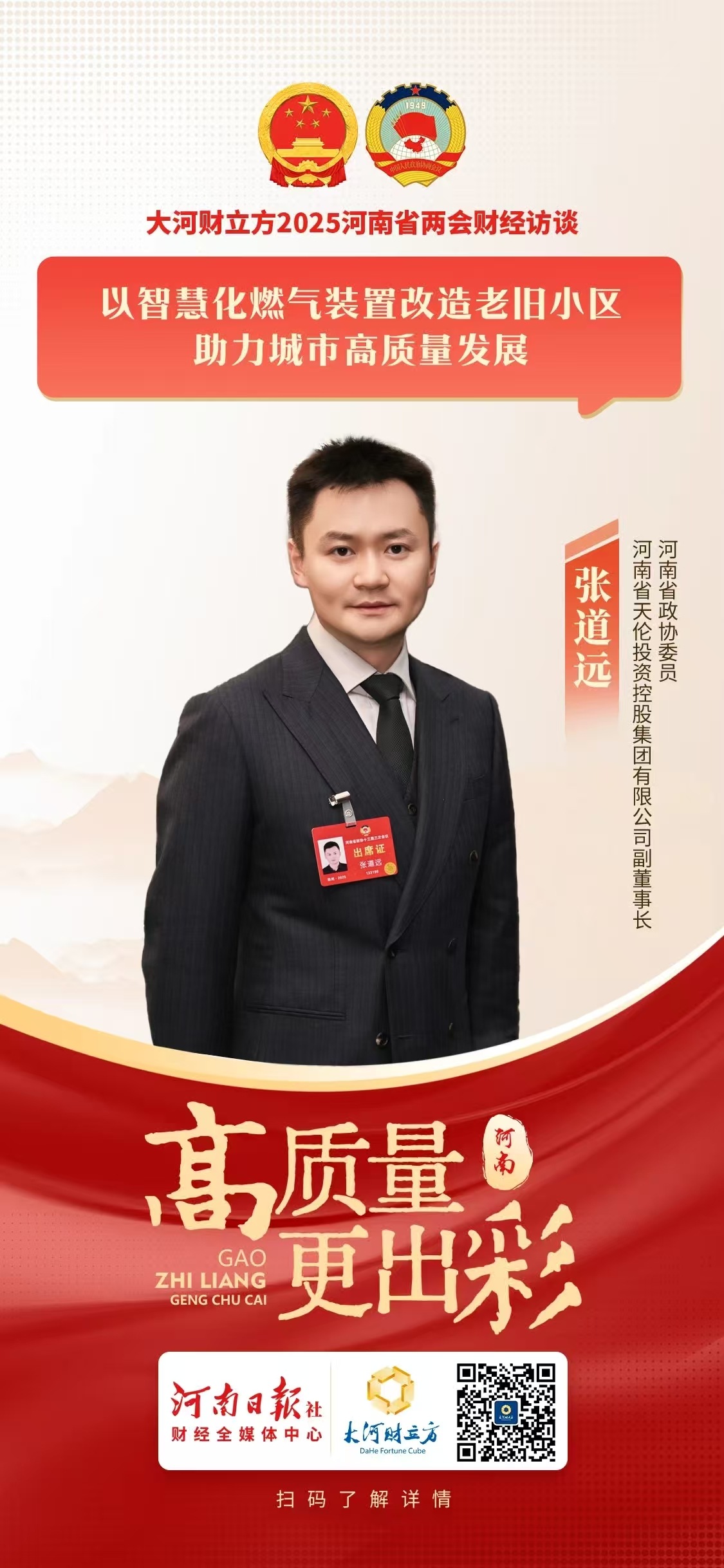
As critical urban infrastructure, the renewal and renovation of aging gas pipelines directly impact millions of households and people's livelihoods. So how can cities effectively renew and renovate aging gas pipelines? During the 2025 Henan Provincial Two Sessions, Zhang Daoyuan, member of the Henan Provincial Committee of the Chinese People's Political Consultative Conference (CPPCC) and Vice Chairman of Henan Tian Lun Investment Holding Group Co., Ltd., proposed promoting the installation of smart gas devices during the renewal and renovation of gas pipelines in old residential communities during an interview with DaHe Fortune Cube.
Recommending Promoting Smart Gas Device Installation during the Renewal and Renovation of Old Communities
"Currently, urban safety risks and challenges are increasing, with frequent disasters caused by extreme weather and occasional safety incidents resulting from gas pipeline leaks, all of which pose serious threats to public safety and socioeconomic development," Zhang Daoyuan stated. He emphasized that by prioritizing residents' needs and driving innovation through smart gas devices, cities can leverage cutting-edge technologies such as the Internet of Things, big data, and cloud computing to achieve intelligent renewal and renovation of urban energy networks, ensuring stable energy supply while reducing safety hazards.
Zhang cited the "government-enterprise-resident" joint funding model for indoor gas facility renewal and renovation implemented by Tian Lun Gas subsidiaries as an example. In 2024, this model was included in the Ministry of Housing and Urban-Rural Development's List of Replicable Policy Mechanisms for Renewal and Renovation of Urban Aging Gas Pipelines (Second Batch). Under this model, over 100,000 households installed "Smart Sentinel" meter-alarm linkage devices. From August 2023 to December 2024, government-enterprise collaboration successfully addressed more than 60,000 gas anomaly alerts, truly realizing efficient "single-map" management and dispatching of urban "lifeline" infrastructure.
Building on this experience, Zhang proposed promoting the installation of smart gas devices during the renewal and renovation of gas pipelines in old residential communities across Henan Province. He offered specific recommendations in five key areas:
(1) Establishing a special working leadership group for the renewal and renovation of urban aging gas pipelines in Henan Province to implement coordinated work and optimize project approval processes. A rapid approval mechanism for urban aging gas pipeline renewal and renovation projects should be established and improved to facilitate quick project implementation and firmly prevent issues such as "approval processes taking half a year while workers wait idly for construction to begin."
(2) Creating a shared funding mechanism for renewal and renovation costs among the government, gas operators, and customers. Smart renovation projects could include: installation of metallic corrugated pipes, deployment of gas safety devices, replacement of interconnected intelligent gas meters for smart home environments, and accompanying installation works.
(3) Relevant government departments should set up a special fund account for the renewal and renovation of aging gas pipelines and establish a funding supervision mechanism. Regular audits should be conducted on how the special funds are used to ensure that the funds are exclusively allocated for their intended purpose.
(4) Implementing tax reduction and exemption policies. After the renewal and renovation of gas pipelines and facilities, operational maintenance enterprises that meet specific conditions should enjoy relevant tax reductions as stipulated by national regulations.
(5) The local government, especially at the township, street, and community levels, should utilize their administrative functions to effectively promote public safety awareness through outreach platforms and fully support the overall renovation of project areas.
Recommending Recognizing Biomethane's Green Value
Given that the "dual carbon" goals (carbon peak and carbon neutrality) have become a global consensus, biomethane, as one form of utilizing renewable biomass energy, is playing an increasingly important role in the decarbonization process of energy consumption.
China is currently the world's largest producer and consumer of biomethane. Projections indicate China's annual production of biomethane will exceed 10 billion cubic meters by 2025 and 20 billion by 2030.
Despite the tremendous potential of biomethane, the industry remains in its early developmental stages. "Currently, many enterprises maintain a wait-and-see attitude toward biomethane procurement, resulting in sluggish industry growth. Meanwhile, the 'green certification' system and societal consumption habits regarding green energy require significant improvement and enhancement," Zhang noted.
To address these challenges, Zhang proposed recognizing biomethane's green value to facilitate energy transition and emission reduction across multiple industries and regions.
Regarding policy support, Zhang recommended that the government enhance continuous policy support, adopting a results-oriented approach based on actual straw processing capacity and production output of biomethane projects. This should include financial subsidies for straw recycling and utilization, agricultural machinery equipment, as well as biomethane production volumes and pricing. Additionally, he proposed improving preferential policies and supporting measures for biomethane projects in areas such as land use, electricity pricing, and taxation, thereby creating a favorable business environment and conditions.
Moreover, he suggested that gas regulatory authorities collaborate with industry associations to establish a "Green Gas Certification Professional Committee" to promote integrated "gas-certification" models and improve policy mechanisms to encourage broader green energy consumption. "Biomethane direct supply could also drive green transformation of traditional industrial clusters, including but not limited to refractory materials, lime, non-ferrous metals, foundries, packaging/printing, and home furnishing manufacturing," Zhang added.