



On April 22, the signing ceremony for a $125 million syndicated loan between Tian Lun Gas and the Asian Development Bank (ADB) was held in Hebi.
This loan marks ADB's first financing initiative for gas pipeline network renovation and has been certified as a "green credit" by United Equator Environmental Assessment Co., Ltd. Under the agreement, the syndicated loan includes a contribution of $100 million from ADB, and a joint contribution of $25 million from Fubon Hua Yi Bank and Korea Development Bank.
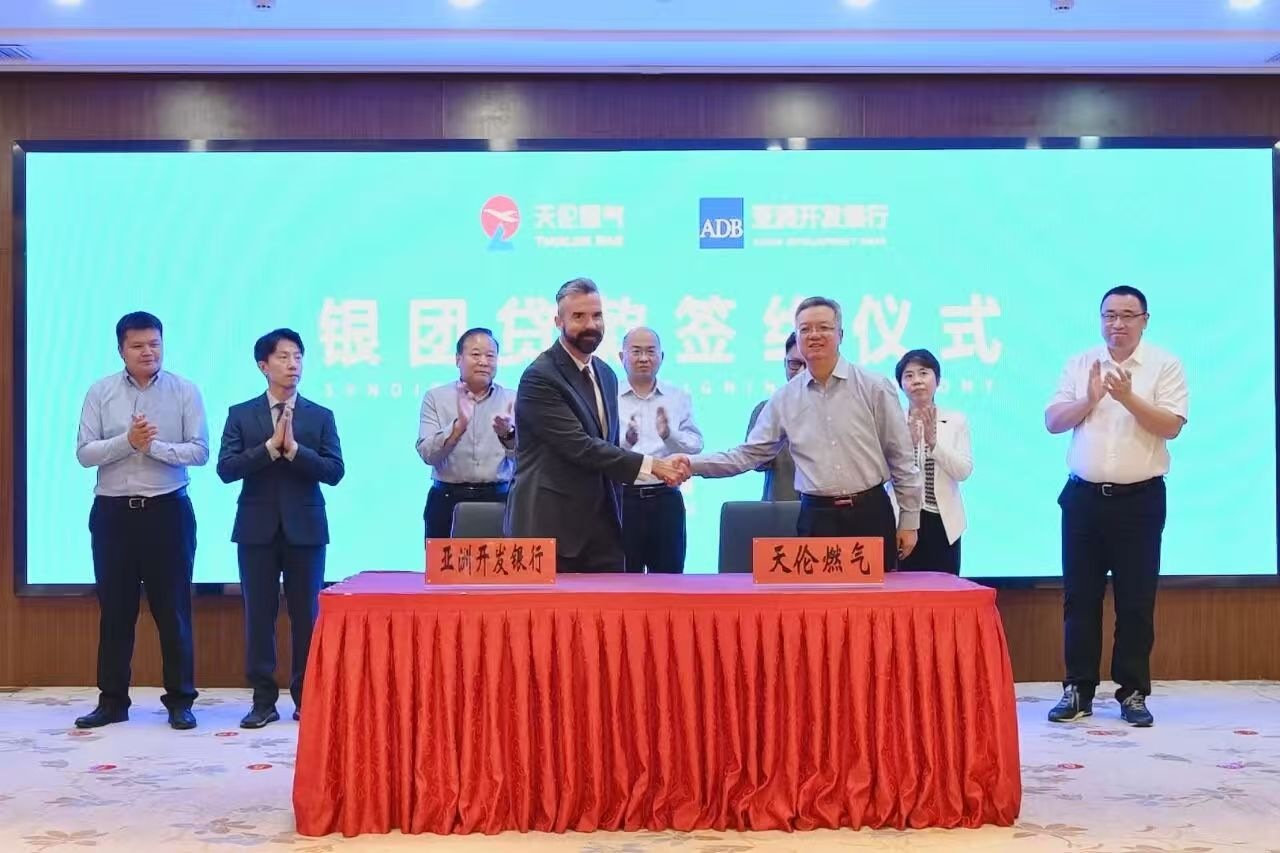
Signing Ceremony for the Syndicated Loan between Tianlun Gas and the ADB
Deepened Cooperation: Tian Lun Gas Secures Another $125 Million ADB Loan
The $125 million syndicated loan from ADB will be used to fund the renewal and renovation of gas pipeline networks and the construction of safety information platforms across Tian Lun Gas' 10 subsidiaries in 5 provinces, significantly reducing methane leaks while ensuring public safety and cutting greenhouse gas emissions.
Specifically, the renewal and renovation efforts of Tian Lun Gas will significantly address safety risks from urban aging gas pipeline networks while installing smart gas meters and digital sensors for at least 500,000 residential customers to enable real-time pipeline monitoring, thereby enhancing safety. Upon detecting leaks, smart meters will remotely shut off valves, while the digital sensors installed along the repaired pipeline will alert operational centers about potential leak hazards.
At the signing ceremony, Tian Lun Gas Chairman and CEO, Xian Zhenyuan, stated in his speech: "For many years, Tian Lun Gas has been deeply committed to gas safety and green development. In terms of safety, we have increased investments year by year, carrying out extensive work in safety functions allocation, safety personnel training, and safety system enhancement. In terms of green development, we place great importance on a sustainable development strategy, striving to become China's leading green and low-carbon energy supplier and service provider. This loan will support the company in renovation aging pipeline networks, replacing smart meters, and enhancing safety measures to reduce methane emissions caused by aging pipelines, improve the climate environment, and enhance the company's safe operation capacity."
Tian Lun Gas has a long-standing partnership with ADB. As early as 2021, Tian Lun Gas received a $50 million loan facility from ADB. the signing ceremony. With the deepening of the partnership between the two parties, this time the ADB has significantly increased the loan amount provided to Tian Lun Gas. Additionally, ADB has partnered with Fubon Hua Yi Bank and Korea Development Bank to jointly explore new models of bank-enterprise cooperation with Tian Lun Gas.
Shane R. Clancy, ADB Senior Investment Specialist, said in his speech: "This project marks another significant achievement for Tian Lun Gas in building safer, greener, and more resilient energy infrastructure. This cooperation is not only a successful financing deal but also a further deepening of the strategic partnership between the Asian Development Bank and Tian Lun Gas. Looking forward, there is still vast potential and space for cooperation between the two sides in the fields of clean energy, urban resilience, and sustainable development."
Representatives from Fubon Hua Yi Bank, Korea Development Bank, HSBC, and Zhongyuan Bank also delivered speeches. Xian Zhenyuan and Shane R. Clancy, representing Tian Lun Gas and ADB, respectively, took the stage to sign the agreement. Leaders from Hebi City, as well as Tian Lun Gas Executive Director and Executive Deputy General Manager, Li Tao, attended and witnessed the signing ceremony.
Innovative Business Model: Building a "Gas+" Energy Service Provider
Founded in 2002 with its first operation in Hebi, Tian Lun Gas has expanded its urban gas business to cover 70 cities across 16 provinces in China, while operating one LNG processing plant and 6 long-distance pipelines. Its subsidiary, Tian Lun Gas Holdings Limited (Stock Code: 01600.HK), was listed on the main board of the Hong Kong Stock Exchange in 2010 and has since grown into a leading urban gas operator in China.
Recently, Tian Lun Gas released its 2024 annual report. During the reporting period, the company's gas sales business maintained steady growth, with total gas sales volume increasing by 7.2% year-on-year to 2.235 billion cubic meters, further expanding its sales scale.
While its terminal retail gas sales business continues to grow steadily, Tian Lun Gas has also achieved remarkable results in innovative business models and advancing the renovation of old residential communities, aligning with its corporate mission of supporting high-quality urban development during the energy industry's accelerated green transition.
Leveraging urban renewal policy opportunities, Tian Lun Gas began promoting the renovation of old residential communities in 2023. Currently, it has deployed nearly 100 projects across 34 cities in 8 provinces, including Jilin, Shaanxi, Qinghai, Gansu, Shandong, Henan, Guangxi, and Yunnan.
In recent years, Tian Lun Gas has integrated the renovation of old residential communities with smart kitchen upgrades. By combining intelligent manufacturing equipment, IoT technology, and concealed pipeline design, Tian Lun Gas has developed a smart kitchen safety system featuring safety monitoring and remote management capabilities. This approach not only optimizes community pipeline networks but also meets residential customers' aspirations for high-quality kitchen environments, strengthening the "last mile" of gas safety. This model enhances residents' quality of life while driving the IoT transformation of households within Tian Lun Gas's service areas, creating a positive cycle of social and corporate benefits and establishing long-term, stable customer relationships.
Tian Lun Gas will take this deepened cooperation with the Asian Development Bank as an opportunity to continue adhering to green development principles. The company remains committed to providing safer, more efficient, and low-carbon energy services to nearly 4 million customers across 70 cities in 16 provinces, contributing to the national goals of carbon peak and carbon neutrality.